Practical guide · Trifaar studio
One Budget, Multiple Specialists: Trifaar's Credit Model
How one transparent credit balance can flex across UI/UX, software engineers, senior engineers, DevOps, and other agreed specialists as product priorities change.
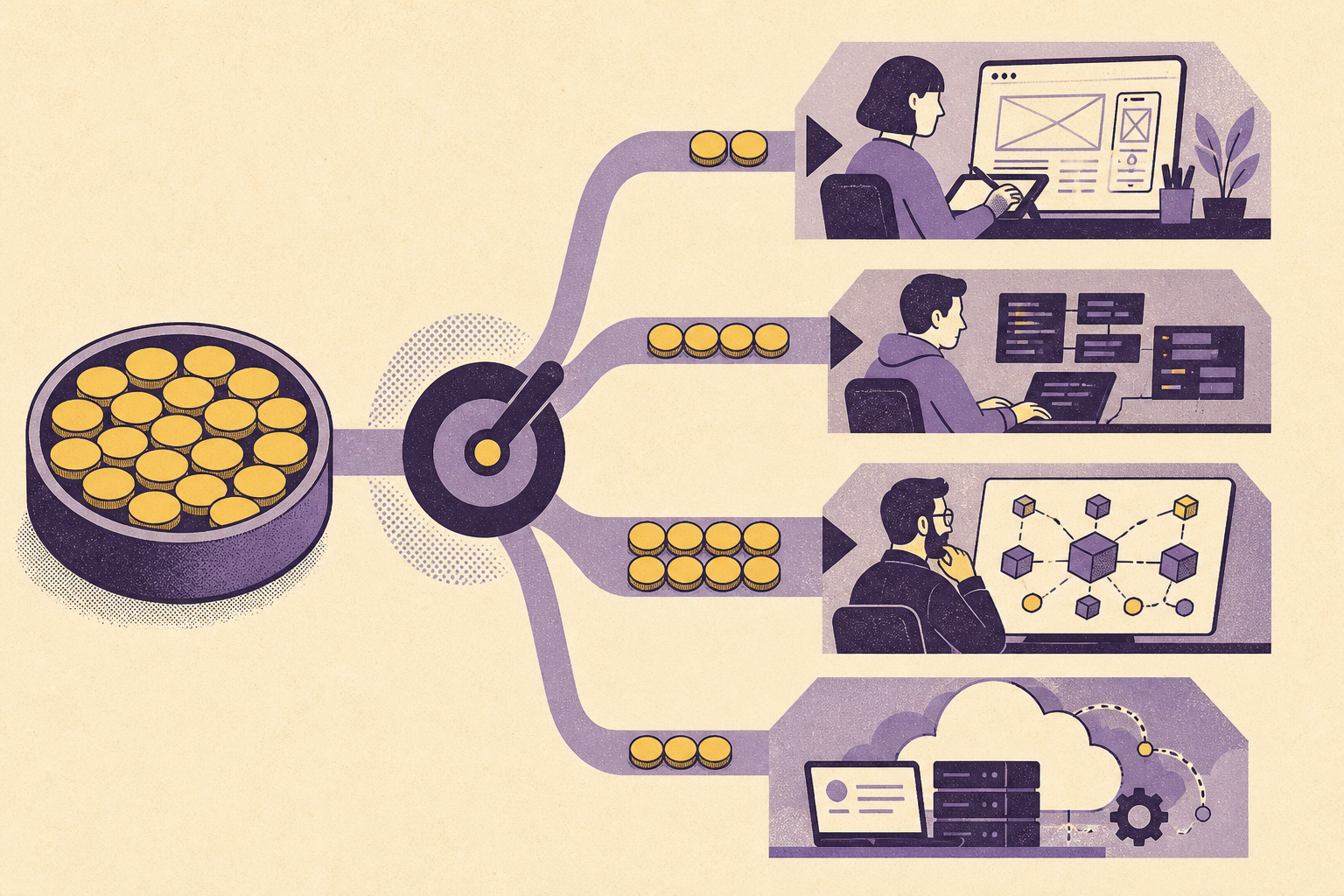
Software work rarely needs the same team shape from beginning to end.
Early on, product and UI/UX work may dominate. During implementation, software engineers carry more of the load. A release can suddenly need DevOps attention, a senior engineer to untangle an architectural decision, or a focused design pass before the next customer test.
The conventional agency answer is often a fixed monthly team. That can be simple, but it also means paying for a staffing shape that may not match the work in front of you. Trifaar's credit model takes a different approach: the client holds one pool of delivery credits and uses it across eligible specialists as priorities change.
What a credit represents
A credit is a common unit for consuming agreed delivery capacity. Different resource levels use credits at different multipliers because the cost and responsibility of those resources are different.
The example multipliers currently provided are:
| Resource | Credit multiplier |
|---|---|
| UI/UX | 1.0× |
| Software engineer (SE) | 1.25× |
| Senior software engineer (SSE) | 1.5× |
DevOps and other specialist roles can also be included, with their multiplier defined in the engagement. We do not publish an assumed number here because the exact commercial setup should be explicit in the client's agreement.
The formula is straightforward:
Credits consumed = agreed capacity units used × resource multiplier
The “capacity unit” is whatever delivery block the engagement defines. It should not be silently treated as an hour unless the agreement says it is an hour.
A 20-credit example
Assume each unit below represents the same agreed block of capacity. A 20-credit pool could support:
- 20 UI/UX units at 1.0×;
- 16 SE units at 1.25×; or
- 13⅓ SSE units at 1.5×.
It can also be mixed. Four UI/UX units consume 4 credits, eight SE units consume 10 credits, and four SSE units consume 6 credits. Total: 20 credits.
That arithmetic is intentionally visible. Clients should be able to see how a planned resource mix affects the balance before work is assigned.
Why the model fits product development
A product backlog changes as evidence arrives. A prototype may reveal that the workflow needs simplification before more code is written. A production issue may make DevOps the immediate priority. A technically risky feature may need a short senior-engineering intervention, after which a software engineer can continue the implementation.
Credits allow the delivery mix to follow those needs without negotiating an entirely new team every time the phase changes.
The model can reduce waste in three places:
- Idle specialism: a role does not need to remain allocated simply because it was useful last month.
- Wrong-level work: senior capacity can focus on architecture, review, and difficult decisions rather than absorbing every routine task.
- Delayed handoffs: a client can move from design to engineering or request release support within the same commercial framework.
It is not a claim that every project will cost less. It is a mechanism for making the resource mix more closely match the work.
What the client should see
A credit model only works when it is legible. At minimum, reporting should show:
- opening credit balance;
- work approved for the period;
- resource type and multiplier;
- credits consumed;
- outputs or backlog items completed;
- remaining balance and upcoming forecast.
Credits should never become a vague substitute for scope. The backlog still needs priorities, acceptance criteria, owners, and a shared definition of done.
How planning works in practice
At the start of a planning cycle, the client and delivery lead choose outcomes rather than filling seats. The team then proposes the smallest useful mix of roles.
A week focused on customer onboarding may need UI/UX and a software engineer. A release week may shift toward engineering and DevOps. An architectural review may temporarily use a senior engineer, then return implementation to the appropriate level.
The client approves the plan with the expected credit consumption visible. If priorities change, the effect on credits is discussed before the mix changes.
When credits are a good fit
The model works especially well when the roadmap is active, the work crosses several disciplines, and the client wants a consistent product partner without keeping every role allocated at all times.
A fixed team may still be better for a large, stable programme with predictable full-time demand. A tightly scoped fixed-price engagement may be better when requirements and acceptance criteria are already settled.
Credits are not meant to hide uncertainty. They give a changing product a controlled way to buy the expertise it needs, when it needs it, from one visible balance.