Practical guide · Trifaar studio
When Multi-Agent AI Is Worth the Complexity
A clear framework for deciding when specialized agents create real value—and when one model, a few tools, and an explicit workflow are enough.
Multi-agent AI is easy to oversell. A diagram with five named agents looks sophisticated even when one well-designed workflow would be faster, cheaper, and easier to maintain.
The useful question is not “Can several agents do this?” It is “Does dividing the work create enough operational value to justify more coordination?”
Start with one model and an explicit workflow
Before adding agents, map the work as a series of inputs, decisions, tools, and outputs. Make the simplest version function end to end. This establishes a baseline for quality, latency, cost, and human effort.
Many products stop here, correctly. A single model with retrieval, a few deterministic tools, and a review step can handle a large range of tasks. More agents mean more prompts, more context transfer, more failure paths, and more traces to inspect.
Add specialization when the work genuinely separates
Multiple agents begin to earn their place when the task contains distinct kinds of judgment that can be tested independently.
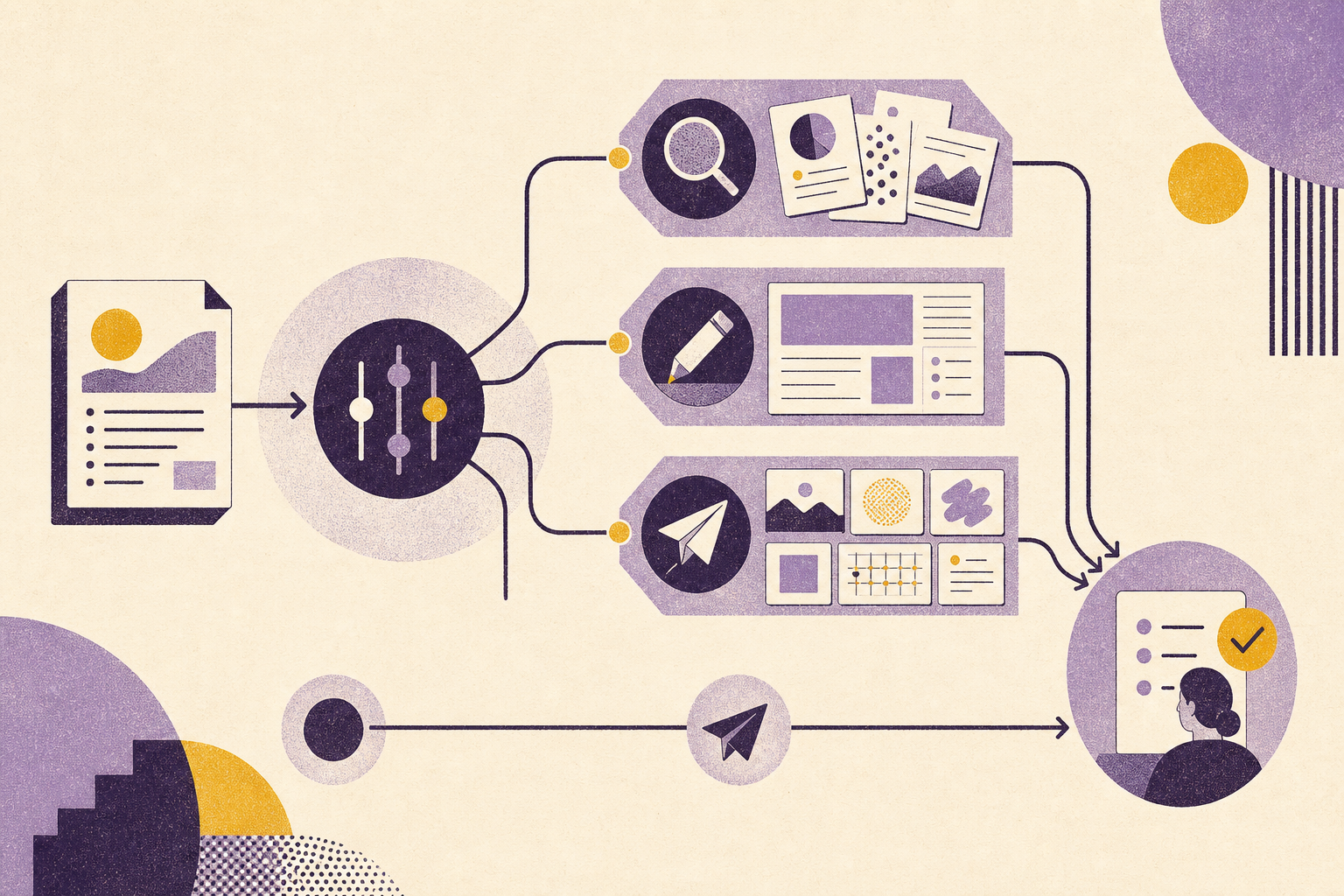
Morning AI is a useful example. Research, drafting, adapting a message for a specific channel, and reviewing against editorial rules are different jobs. Giving them clear boundaries made it possible to improve one stage without destabilizing the others. The system could also preserve one shared content brief while producing channel-specific outputs.
The delivered workflow reduced the client's reported content-production time by 83%. That result is a first-party project outcome, not a general promise about multi-agent systems. The architecture worked because it followed a real editorial process and ended in operational publishing workflows—not because the agents had clever names.
Good reasons to split the system
A separate agent or model step may be justified when:
- it needs a different tool set or permission boundary;
- it has a distinct evaluation rubric;
- it can run in parallel with independent work;
- it needs different context from the rest of the workflow;
- a specialist model can handle it more efficiently;
- a human must approve the handoff before the next action.
These are engineering boundaries. “One agent per department” is usually an org-chart metaphor, not a system design.
The coordinator must be boring
The most dependable orchestration is explicit about state. It knows which step is active, what inputs are required, what output schema is expected, what may be retried, and what happens after failure.
Free-form conversations between agents can be useful for exploration, but they are difficult to operate when the product must publish a campaign, update a record, or deliver a customer-facing result. Structured handoffs reduce ambiguity. Checkpoints prevent a temporary failure from erasing completed work. Idempotent actions prevent retries from causing duplicates.
LangGraph's orchestration model emphasizes durable execution, persistence, and human-in-the-loop controls. Those capabilities address the unglamorous problems that appear after a multi-step system leaves a demo environment.
Review the handoff, not every token
Human oversight works best at decision points. In a marketing workflow, a reviewer may approve the final channel package before scheduling. In an analytics workflow, a reviewer may inspect source evidence when confidence is low. In an operations workflow, a proposed action may pause before changing external data.
An approval should show enough context to make a decision: what the system proposes, why, which evidence it used, and what action follows. Asking a person to review an unstructured wall of agent messages creates more work than it removes.
Evaluate the system at two levels
Each specialist step needs a local test. The full workflow needs an end-to-end test.
A research step may retrieve relevant facts, while the final draft still omits the most important one. A channel adapter may follow a format perfectly while inheriting an unsupported claim. Local scores help diagnose; task-level success tells you whether the product works.
Track at least:
- completion rate for the full job;
- accuracy and policy compliance by stage;
- human edit or rejection rate;
- number of model and tool calls per completed job;
- total latency and cost;
- failures, retries, and abandoned runs.
When multi-agent is the wrong choice
Avoid it when the task is short, the stages cannot be evaluated independently, shared context is larger than the work itself, or a deterministic function can perform the handoff. Also avoid it when the team lacks tracing and evaluation. Complexity without visibility is simply a more expensive way to be uncertain.
DORA's research offers a broader warning: AI can amplify the strengths and weaknesses of the delivery system around it. Faster generation does not automatically create more stable software. The same applies inside an AI product. More agents amplify a sound workflow; they do not create one.
The right multi-agent system feels less like a panel discussion and more like a well-run production line: narrow responsibilities, visible state, controlled handoffs, and a person at the decisions that deserve one.